Feathers: The Blueprint of Innovation
At the end of most airliner wings are small upturned tips called winglets. Invented by British engineer Frederick Lanchester for model gliders over a century ago, they weren't added to airliners until the 1980s. Lanchester's design was inspired by eagles, which flex their wingtips upward while soaring.
Birds have inspired human inventions for millennia. Japanese bullet trains mimic kingfisher beaks, and woodpeckers' shock absorption could protect airplane black boxes. Bird feathers, admired for their versatility, repel water, mask sound, display color, and provide camouflage—remaining lightweight, soft, and warm. This natural covering, refined over millions of years, still surpasses human-made materials.
The gap between natural feathers and engineered materials stems from scale. The best 3D printers achieve precision of about one hundredth of a millimeter, but feather keratin filaments operate at the nanometer scale, 10,000 times more intricate.
Feathers impress engineers by serving multiple functions simultaneously.
Feathers enable flight, being strong, lightweight, and soft. Birds use flight to escape predators, hunt, or migrate thousands of miles. Flight has let birds spread globally and inspired inventors for centuries.
The ancient Greeks told of Daedalus and Icarus, a tragedy about ambition's dangers. Daedalus made wings from feathers, but Icarus flew too close to the sun, fell, and died. Today, such wings would be biohybrid—combining real feathers with synthetic machines. Researchers like Lentink use biohybrid drones to mimic bird flight, even creating a robot that lands like a songbird.
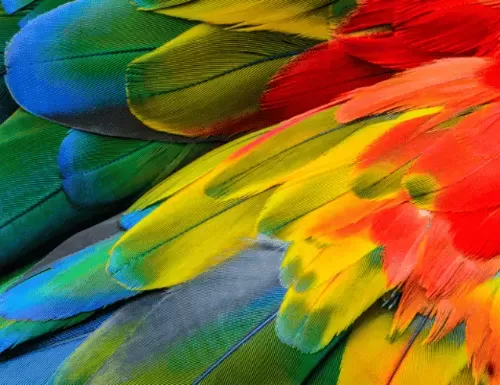
After flight, feathers also serve color functions. Birds use color to attract mates, like peacocks and cardinals, or to hide, like female ducks and song sparrows. Hummingbirds create iridescence with layered pigments.
Feather color inspires more than beauty. Researchers are creating efficient solar panels by reflecting infrared and ultraviolet light, mimicking feathers of arctic redpolls and snowy owls.
Feathers insulate and regulate bird temperature. Goose down, unmatched in warmth-to-weight ratio, has been used for centuries. Penguin feathers inspire all-weather textiles and polymer aerogels for insulation and climate control, mimicking their triple-layer structure.
Feathers generate or eliminate sound. Hummingbird tails produce a trill during dives to attract mates. Owls' silent wings aid stealth hunting, inspiring quieter aircraft designs.
Another impressive feather function is their interaction with water.
Duck feathers inspired sustainable gelatin food packaging with better freshness than plastic. Birds of paradise inspired new evaporation tech for seawater desalination, performing well in wet conditions like rainforest birds.
Feathers self-repair better than human engineering. Birds replace feathers regularly and during molting, but many recover from minor damage. Feather parts separate and reform seamlessly—engineers aspire to replicate this. Running a finger down a flight feather separates its barbs, but they quickly realign.
This self-repair mechanism inspires new soft electronics designs, like insulators and semiconductors. They may someday reorganize into working patterns after damage, like pigeon feathers have for millions of years.
Feathers, made of keratin like hair and nails, vary across 10,000 bird species—from hummingbird bristles to condor flight feathers—yet all stem from this single material.