Tree-Dwelling Salamanders' Secret Grip
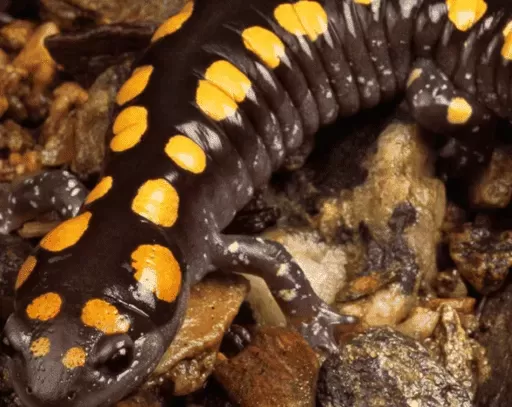
The roving salamander is not your typical amphibian. Its lifestyle is arboreal, rather than skulking behind logs or swimming in wetlands. These amphibians, which are native to redwood forests, reside mostly inside trees, living in the deep cracks in the bark and feeding on insects.
Since wandering salamanders glide over trees for supplies and foraging, and because their homes are more than 300 feet (90 meters) above the ground, they require a lot of grip while landing, or else they risk falling to the forest floor.
Wandering salamanders have a special gliding mechanism—18 blood-powered toes—to keep themselves secure. The salamander's ability to precisely leap and land through the intricate canopy depends on these unique appendages.
The wandering salamander uses the tips of its square toes to pump and drain blood in order to maintain its hold on the tree bark, according to research published in the Journal of Morphology.
Researchers have previously hypothesized that their feet's oxygenation was maintained by the brilliant blood flow underneath their transparent skin. Nevertheless, this assertion was not supported by any actual data.
Biologists under the direction of Christian Brown, a researcher at Washington State University, used high-resolution video experiments to find that wandering salamanders may asymmetrically increase or reduce the contact area with the surface by carefully controlling the blood flow to either side of the toe tip.
The salamander rapidly saturates the tips of its toes with blood as it gets ready to leap over trees. Because the blood inflow raises the blood pressure and causes the toe pads to temporarily expand, the increased blood pressure aids in the salamanders' ability to separate from the tree. It is simpler to separate from the surface because of the modest elevation that decreases the contact area.
The opposite procedure is as important; when roaming salamanders settle, they quickly drain the blood from their toe tips. By increasing surface contact and softening the toes, this enables them to better adapt to the uneven and rough ground, giving the salamander a more reliable and strong grip that keeps it from slipping.
Depending on whether they are stepping, clutching, or releasing, they dynamically adjust the pressure.
In a statement, Brown added that having the ability to detach effectively without harming one's toe tips is crucial while climbing a redwood with 18 toes clutching the bark.